

This article is a companion to our original guide, Your Guide to Success on the GRE Essay (Analytical Writing Section). That piece walks you through the strategy, structure, and mindset you need to succeed on the GRE Analytical Writing task. Here, we follow it up with a complete sample essay and a step‑by‑step outline so you can see those strategies in action. If you haven’t read the original guide yet, we recommend starting there — then come back here to review a full, scored example you can learn from and model.
Brainstorm (~5 minutes)
- First, read the prompt and figure out what Agree or Disagree would generally mean
- Then, make a T-chart and try to come up with reasons for both; you are done once you have at least 3 for one side, 1 for the other. The side with three will be your side.
Write the Introduction, and start the Conclusion (~5 minutes)
- Write some stuff about the topic itself – this is a chance to easily add to the word count, since you can just write about the topic without making any persuasive points yet.
- Write the Thesis; this will be the last sentence of the Introduction, and will state the side you have three reasons for:
- When it comes to the question of [prompt], I [agree/disagree] for the reasons of [reason 1], [reason 2], [reason 3].
- Next, start a new paragraph, and start off with “In conclusion,” and then reword the Thesis into the past tense (to show that you have already done this)
- In conclusion, on the topic of [paraphrase the prompt differently], I have shown that [reword the general argument based on whether you chose agree/disagree] for [reasons 1, 2, 3].
- You can add some more details at this stage, but this is functionally enough for now; you can elaborate more if you manage to finish the rest of the essay early.
- Between these two paragraphs, you’ll add the next parts.
Write 3 Body Paragraphs (~12 – 15 minutes)
- Make sure to use signposting text and write a topic sentence to start each paragraph
- To start, the first reason why [agree/disagree with prompt] is because [reason 1]
- One reason why [restate stance on prompt] is that [reason 1]…
- Then, just elaborate on the reason, and try to write as much as you can about it.
- To further increase the word count, you can add a closing sentence as well; this can be a rewording of the topic sentence.
- Thus, a critical reason for why [agree/disagree with prompt] is [reason 1]
Write the Concession Paragraph (~5 minutes)
- Now we’ll use the one reason for the other side we came up with during the brainstorming; use signposting language to signal that this is the counterargument
- While it can be argued that [reason for the other side]…
- Next, write 1-2 sentences explaining why this poses a problem for your argument.
- Finally, refute this argument and explain why your side still wins out.
At this point, if you have extra time, you can proofread what you’ve written thus far, and flesh out the Conclusion with some more word count, and that should do it!
Sample “Analyze an Issue” Brainstorming Process
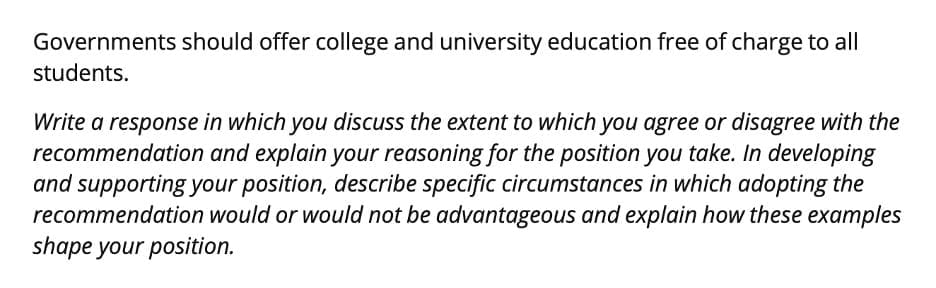
- Let’s give ourselves a few minutes to think this over and define what agree and disagree would mean in this context. We don’t have to overcomplicate it; a simple way to view this is that Agree is why this is a good idea and Disagree is why this is a bad idea.
- Next, we’ll write out some reasons for both sides. You might have some background knowledge on this (e.g. examples of countries where this is already implemented) but even if not, just write what comes to mind; feel free to use simple or even naive ideas!
Agree
- Would lead to a more educated general population
- Improve suitable employment
- Could help increase innovation within the country
Disagree
- Students could abuse the system by signing up for endless classes and staying in university indefinitely
Since we have three reasons for Agree, this is the side that the essay will take. We can take a brief look at the Disagree to see what we need to do to counter this. Sometimes, we might naturally come up with a very strong reason for the other side, and this could give us some anxiety when it comes to refuting it. Here, the reason we came up with for Disagree does seem quite strong! We could just come up with a much weaker reason instead. But, under time constraint, this could be difficult, so here’s the thing: we don’t necessarily even have to refute it fully! We can acknowledge it and adjust our argument accordingly. For instance, we could say that governments could add the stipulation that this only applies for the first degree, and that different majors could have a list of what qualifies under free; if students deviate significantly, or take on too many additional courses, then they’ll have to pay. Note that explaining this in detail helps us add more to the word count!
Sample “Analyze an Issue” Essay
The costs of higher education have been steadily increasing for years, and, in many institutions, have reached levels that are generally unaffordable for the average aspiring student without financial aid or substantial loans. As a result, many capable students, who would otherwise pursue higher education, are now being discouraged in the face of such prohibitive rising costs. This has raised the question of whether governments should offer students the opportunity to pursue higher education free of charge. I believe that governments should offer free college and university education to students, because doing so would lead to a more educated general population, improve employment outcomes, and help increase innovation in the country.
One reason why I agree that higher education should be tuition-free is that it would lead to a more educated general population, which benefits society at large. People who have undergone higher education have spent more time engaging critically with conflicting ideas, which can help them be more informed voters and better participants in civic life. Without such education and experience in critically assessing ideas, people may be more likely to believe misinformation or rely on oversimplified arguments when forming or expressing opinions about important issues in public discourse. By making college and university education free of charge, governments can remove financial barriers to higher learning and more easily encourage people to pursue higher education and therefore improve the quality of their population’s participation in civic discourse. Thus, governments offering free higher education would be beneficial for their societies by increasing overall education and improving critical thinking about public issues.
A second reason why governments should strongly consider making higher education free of charge is that doing so would improve employment outcomes by increasing access to credentials that the labor market increasingly requires, while reducing the debt burden that many students currently take on to earn those credentials. An ideal outcome for students would be for them to take on employment roles that they feel suited for or drawn toward; for instance, students may find themselves naturally drawn to roles that greatly benefit society, such as nursing, social work, or public service. However, many such roles now require some form of degree from a college or university. Students who attend these programs often graduate with substantial debt, and this can financially pressure them into taking on roles that they may not be suited for. For instance, a graduate who would otherwise pursue work in social work or public service might feel forced to take on a high-pressure job in finance instead in order to pay off his or her loans. In other cases, students may avoid higher education entirely, leaving them blocked from careers that could have been not only meaningful to them, but also useful to society. In sum, if governments lowered the financial risks of pursuing a degree by offering tuition-free education, they could help people work in careers that are not only better suited to their interests but also societally beneficial.
A final reason for why governments should make higher education tuition-free is that doing so would improve innovation in the country. Colleges and universities act as research hubs and training grounds where students can learn advanced technical skills and hone their natural abilities to their full potential. When tuition is expensive, some otherwise talented students may never enroll, and the country could lose out on potential inventors, engineers, scientists, and entrepreneurs as a result. By contrast, if higher education were free, more students from a wider range of backgrounds could enter these programs, contribute different perspectives, and participate in research and opportunities that could lead to new and innovative technologies and businesses being developed. Over time, having a larger and more diverse pool of educated workers makes it more likely that the country will produce breakthroughs that increase productivity and strengthen its economy. Therefore, if governments made higher education free for students, they could improve the overall level of innovation in their countries.
Admittedly, opponents of this proposal could make the counterargument that a policy of making higher education free could invite abuse. For instance, students could enroll indefinitely and refuse to graduate, while taking on large amounts of classes that have little to do with their chosen majors. This can cause issues because institutions of higher education are expensive in large part due to administrative and staffing costs, and public budgets are finite; if students abuse the system this way, the general quality of higher education could be reduced as a result. However, this doesn’t necessarily mean that governments should flat out reject the notion of free education; rather, it means the policy should include reasonable limits. For example, governments could cover tuition only for a first degree and furthermore limit such coverage to be only for a set number of years. They could also cap the number of subsidized credits and charge students for excessive extra courses. With these safeguards, the risk of abuse is reduced, while the benefits of increased access to higher education are retained.
In conclusion, when it comes to the question of whether governments should provide college and university education to students free of charge, I have shown that doing so would be beneficial as it would help develop a more educated population, improve employment and mobility outcomes, and boost innovation in the country.